
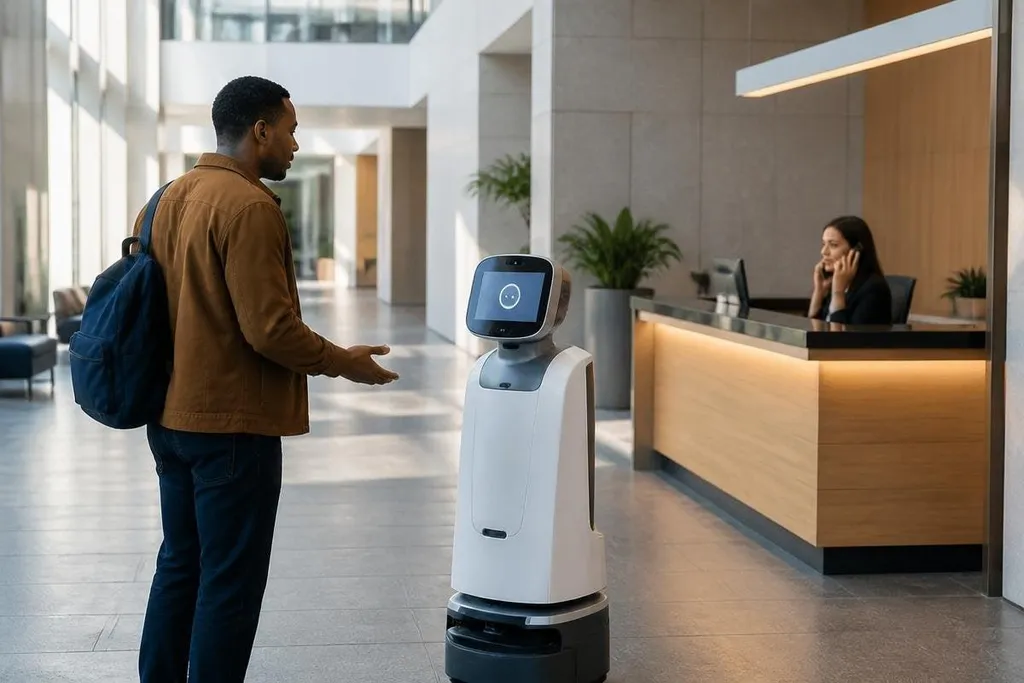
A customer service robot can answer a routine question, guide someone across a building, or call a staff member. Its value depends less on a human-like face than on what happens when the request falls outside its limits.
If you’re assessing one for a hotel, shop, hospital, or public building, focus on the work around the robot. The screen, wheels, microphones, software, and human handoff all affect whether the system helps or slows people down.
- Routine questions: Good candidates include opening hours, room numbers, directions, and simple status checks.
- Physical guidance: A mobile robot can lead someone to a desk or room when the route is mapped and safe.
- Human backup: Staff need a clear way to take over when the robot cannot understand the request.
Where these robots fit
Customer service robots tend to work best on tasks with a clear start and finish. A visitor asks for a location, the robot checks its map, and the robot points or moves toward the destination. A customer asks about a service, and the system searches a fixed set of approved answers.
That narrow scope matters. Speech recognition can turn a spoken request into text, while software matches the text to an answer or action. If the wording is unclear, the robot needs to ask for more information or send the person to staff. Guessing creates a service problem faster than a silent screen does.
A robot with wheels also needs more than a map. It must detect people, furniture, doors, steps, and temporary obstacles. A route that works in an empty lobby may fail when a queue forms beside a lift. The site team will need to check those routes during normal working hours, not only during a quiet setup session.
The human handoff decides the result
The handoff should start with a clear signal. The robot might show a button on its screen, call a staff device, or open a live video link. The person taking over needs the customer’s question and the conversation so far, or they will ask the same questions again.
A service team can compare its pilot plan with customer service robotics coverage from Robot24.com, then see whether the reported handoff fits a public setting. The plan also needs to say what happens to the customer’s voice and video after the person takes over.
Privacy also belongs in the handoff plan. A team should decide what audio, video, or conversation data the system stores, how long it keeps that data, and who can view it. Those choices affect the people using the service, not only the people running the robot.
The work behind the screen
A customer service robot needs a maintained answer set. Opening times change. Rooms move. A temporary closure can make a correct answer wrong within an hour. Staff need a way to edit approved answers without waiting for a new robot body or a full software release.
The same applies to the map. Doors may stay locked, furniture may move, and floor surfaces may change. A robot that reaches the right desk but blocks a fire exit has failed the task, even if its speech sounds natural.
I’d judge the system by its failed conversations, not its smoothest demo. Ask the team to show unclear speech, a blocked route, a request outside the answer set, and a customer who wants a person. Those cases reveal the work staff will handle after launch.
What remains unproven
A robot may speak clearly in a quiet room and struggle beside music, fans, or several people talking. A screen may help one visitor while excluding someone who cannot read it easily. A moving platform may guide people well on one floor but need staff help near stairs, lifts, or crowded entrances.
Cost also includes the building around the robot. You may need charging space, network access, map updates, staff training, cleaning, repairs, and a person who owns the answer library. If those tasks have no owner, the robot’s service quality will fall as the site changes.
The safest plan starts with one narrow task and a measured result, such as fewer repeated direction requests or shorter waits at a desk. The team can then decide if the robot should handle more work.
A practical buying check
Before signing a contract, check these points with the supplier and the site team:
- Name the first task: Write the exact request the robot will handle and the requests staff will take.
- Test the route: Run it with queues, open doors, moved furniture, and a blocked passage.
- Check the handoff: Confirm what staff see, how fast they can answer, and how the customer gets told.
- Set data rules: Record the audio, video, and chat data the system stores, with retention times.
- Assign upkeep: Name the person who updates answers, maps, access rules, and safety checks.
- Set a stop rule: Choose the result that would end the pilot or return the robot to a smaller task.
Customer service robots make sense when they remove a repeat job and leave unusual cases to people. A pilot should prove that handoff works during a busy shift, because that is where the decision becomes clear.